
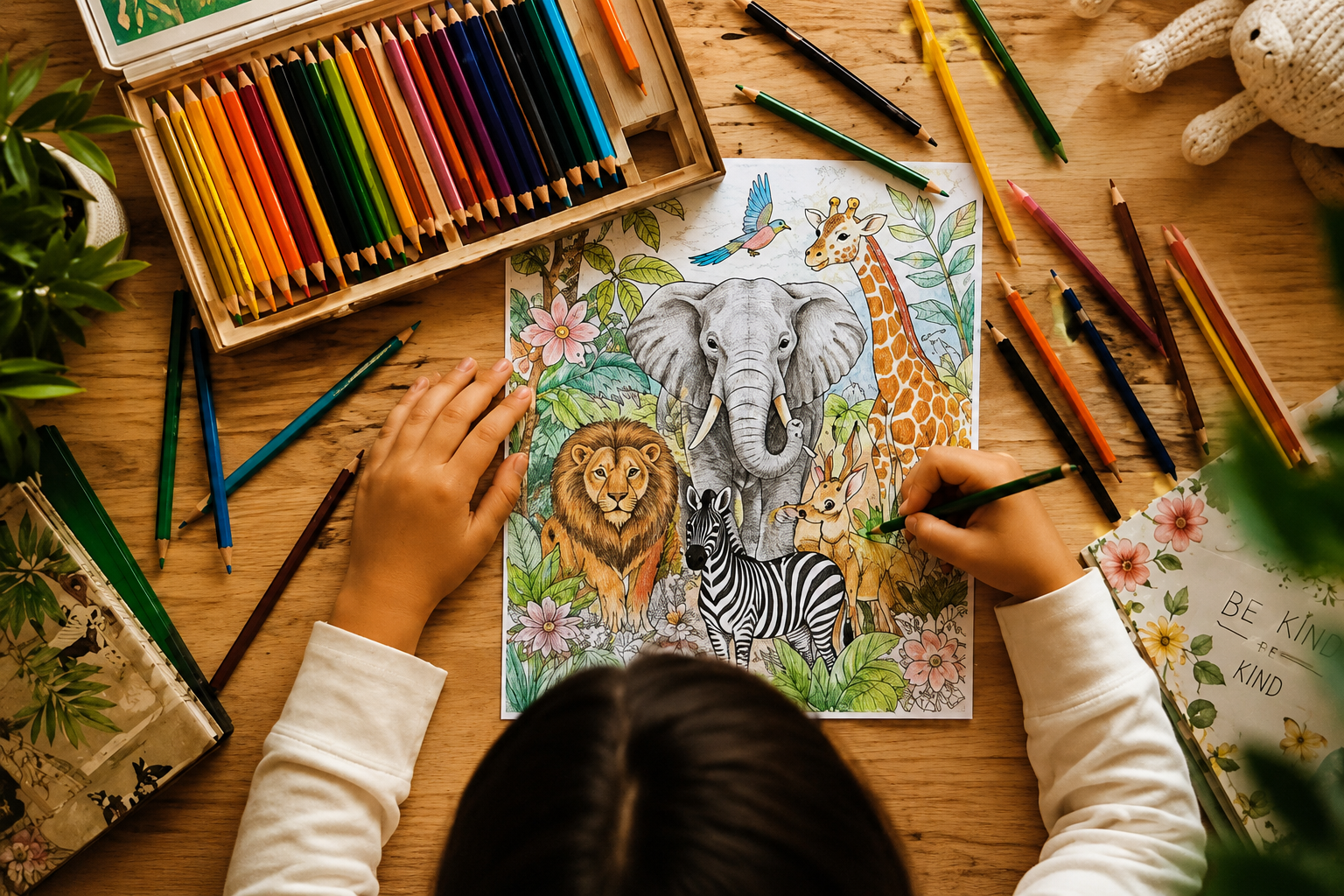

If you’ve ever handed your child a coloring page just to get five quiet minutes during a hectic homeschool morning, you’ve probably noticed something interesting happen. The wiggling stops. The chatter fades. Their shoulders relax, and their eyes lock onto the page.
What looks like “just coloring” can actually support several skills children use for learning. Coloring gives kids a simple, screen-free way to practice fine motor control, hand-eye coordination, concentration and creative expression—all while doing an activity that feels like play.
Coloring pages have been a staple in classrooms and playrooms for generations, but their value goes beyond keeping little hands busy. From building the hand strength children need for handwriting to reinforcing colors, shapes, numbers and other concepts, the right coloring activities can become a useful part of learning at home.
In this guide, we’ll explore 7 ways coloring pages can support kids’ learning and focus, show you practical ways to use them in your homeschool or home-learning routine, and share free printable samples you can try with your child today.
The Science Behind Coloring and Child Development
How Does Coloring Help Children Learn?
Coloring may look like a simple activity, but it asks children to use several skills at the same time. They have to hold and control a crayon or pencil, coordinate what their eyes see with how their hands move, make choices about colors and details, and stay engaged with the page long enough to complete part or all of the activity.
Because coloring combines movement, visual attention and creativity, it can be a useful addition to learning at home. A child might color an alphabet page while practicing letter recognition, work on an animal page while learning new vocabulary, or use a number-themed coloring activity alongside an early maths lesson.
The key is to treat coloring as a supportive learning activity rather than a replacement for instruction or active play. When it connects naturally with what a child is already learning, it can make practice feel more enjoyable and give children another way to engage with a concept.
Building Fine Motor Skills
One of the clearest developmental benefits of coloring is the opportunity to practice fine motor control. Holding crayons and colored pencils, changing direction, filling smaller spaces and gradually learning to stay within outlines all require controlled movements of the hands and fingers.
These are some of the same foundational skills children use for tasks such as writing, drawing, using scissors, buttoning clothes and handling other small objects.
As you may have guessed, Coloring Pages Boost Kids’ Learning & Focus in a variety of ways.
Building Fine Motor Skills
Every time your child picks up a crayon and works across a coloring page, they’re practicing controlled movements of the hands and fingers. Gripping the crayon, changing direction, filling smaller areas and adjusting pressure all give children opportunities to develop the fine motor control they will also use for handwriting, cutting with scissors, fastening clothes and other everyday tasks.
Research has explored the use of picture-coloring activities as a way to support fine motor development in young children. One study involving children aged 4–5 reported improvements in fine motor development following structured picture-coloring activities. (ResearchGate: The Influence of Picture Coloring on Fine Motor Development)
There is also a coordination element that is easy to overlook. While one hand colors, the other often holds or adjusts the paper. These simple two-handed activities give children additional opportunities to practice coordinating their movements during everyday play and learning.
Strengthening Hand-Eye Coordination
Coloring also requires children to coordinate what they see with how they move their hands. They look at the shape or area they want to color, guide the crayon toward it and continually adjust their movements as they work.
For younger children, the goal doesn’t need to be perfectly staying inside the lines. Scribbling, experimenting with different strokes and gradually gaining more control are all part of developing confidence with drawing and coloring tools.
As children become more precise, coloring can provide additional practice with the visual-motor coordination they also use when drawing, forming letters and completing other hands-on learning activities.
Cognitive Benefits: More Than Fine Motor Practice
Building Concentration Through Short, Focused Activities
Completing a coloring page gives children an opportunity to stay engaged with one activity for a period of time. For younger children, that might only be a few minutes—and that’s perfectly fine.
Instead of expecting a child to finish an entire page, parents can use short coloring sessions as part of a learning routine. For example, five or ten minutes of coloring before a lesson can provide a gentle transition from free play into a more structured activity.
The goal isn’t to use coloring as a guaranteed way to “fix” a child’s attention span. Rather, it can provide a calm, low-pressure opportunity to practice staying with a task.
Encouraging Creativity and Decision-Making
Even a simple coloring page gives children choices to make. Which color should they use? Should the sky be blue, pink or purple? Should they use one color or several? Do they want to add their own drawings around the original picture?
These small decisions encourage experimentation and creative expression. There doesn’t have to be a “correct” color choice. Allowing children to make some of their own decisions can turn a printable coloring page into a more open-ended creative activity.
You can encourage this by asking questions such as, “What made you choose that color?” or “What else could we add to this picture?” rather than focusing only on whether the page looks neat.
Using Coloring to Reinforce Learning
Coloring becomes particularly useful for learning when the picture connects with a concept your child is already exploring.
For example, a child learning about animals could color different habitats. A geography lesson could include a simple map-coloring activity. Younger children learning colors could match crayons to familiar objects, while alphabet or number coloring pages can provide another way to revisit early concepts.
The coloring itself shouldn’t replace teaching, conversation or hands-on exploration. Instead, think of it as one more way for children to interact with information they are learning.
For younger children who are currently learning basic colors, you can also try our guide to How to Teach Colors to Toddlers: 10 Easy Coloring Activities at Home.
Emotional and Psychological Benefits
Creating a Calm, Low-Pressure Activity
Many parents notice that coloring can feel calming because it gives children one simple activity to focus on without the pressure of getting a school answer “right.” Choosing colors, making repetitive movements and watching a picture gradually take shape can create a quiet pause in a busy day.
Research into the emotional effects of coloring has found reductions in anxiety in adults completing structured coloring activities, including mandala-style designs. While those findings should not automatically be applied to children, they help explain why coloring is often explored as a relaxing creative activity. (Curry & Kasser, “Can Coloring Mandalas Reduce Anxiety?”)
At home, coloring can simply be offered as one option when a child needs some quiet time. A short coloring break between lessons, after an active activity or during a busy homeschool day can provide a gentle transition before moving on to the next task.
It is important not to present coloring as a treatment for anxiety or emotional difficulties. Think of it instead as an accessible creative activity that some children may find relaxing and enjoyable.
Building Confidence Through Completion
Finishing a coloring page gives children something concrete they can look at and say, “I made that.”
That sense of completion can be especially encouraging for younger children. They can see their progress as a blank page gradually becomes something colorful and personal.
Parents can reinforce this confidence by focusing on effort and choices rather than perfection. Instead of saying, “You stayed inside all the lines,” try comments such as, “You spent a lot of time working on that,” or ask, “Which part are you most proud of?”
This keeps coloring creative rather than turning it into another activity children feel they have to perform perfectly.
How Coloring Pages Can Complement Homeschooling
A Flexible Learning Tool for Different Subjects
One of the biggest advantages of printable coloring pages for homeschooling is their flexibility. Instead of using them only as a filler activity, you can choose pages that connect directly with something your child is already learning.
For example:
- Science: solar systems, life cycles, animals, the human body and weather
- History: historical figures, clothing, buildings and important events
- Language arts: letters, vocabulary, story characters and simple writing prompts
- Geography: maps, flags, continents, landmarks and landscapes
- Math: numbers, shapes, patterns and age-appropriate color-by-number activities
If you’re building a themed lesson or unit study, you can also browse our animal coloring pages for animal and nature topics or our landscape coloring pages for geography, seasons and nature-inspired activities.
The important part is the connection. A coloring page becomes more educational when you talk about what your child is coloring, ask questions about it or use it alongside books, experiments and other hands-on activities.
Making Visual Concepts More Concrete
Some subjects naturally benefit from visual examples. Coloring a map, animal, plant or weather scene gives a child time to look closely at its different parts while you discuss what they represent.
For example, rather than simply handing your child a plant diagram to memorize, you might talk about the roots, stem, leaves and flower as your child colors each section. The conversation and interaction with the picture—not simply adding color—are what turn the page into a richer learning activity.
Encouraging Age-Appropriate Independent Activity
Coloring can also provide useful independent activity time during a homeschool day.
Once children are comfortable using crayons or colored pencils safely, they may be able to work on an age-appropriate coloring activity while a parent prepares the next lesson or works with another child.
For younger children, keep the activity simple and expectations realistic. Independent coloring doesn’t need to mean completing an entire detailed page. A few minutes of engaged, screen-free activity can be enough.meschool Learning
Build Coloring Into Your Routine
Coloring can be easier to use consistently when it has a natural place in your homeschool routine. You might offer a coloring activity after morning basket time, between two subjects, while you’re preparing the next lesson, or as a quiet activity after lunch.
The goal isn’t to create another rigid item on your schedule. Instead, use coloring when it helps create a smoother transition between activities.
For example, if your child has just finished an energetic activity and isn’t ready to sit down for reading or maths, a few minutes with crayons and a simple coloring page can provide a gentler bridge into the next part of the day.
Use Coloring for Group or Co-op Activities
Coloring pages can also work well when you’re homeschooling several children or participating in a homeschool co-op.
Children can work on the same themed page while talking about what they’re learning, compare their different color choices or collaborate on a larger activity connected to the lesson.
You could even give children different pages on the same topic. During an animal unit, for example, each child could color a different animal and then share one interesting fact about it with the group.
That turns a simple printable into an opportunity for conversation, creativity and participation without requiring an elaborate group project.
Reinforce What You Just Taught
Try using a themed coloring activity after introducing a new concept.
Teaching the water cycle? Your child could color a simple water-cycle diagram while you talk together about evaporation, condensation and precipitation.
Learning about butterflies? Color the stages of a butterfly’s life cycle and ask your child to explain what happens at each stage.
Studying geography? Use a map or landmark coloring page alongside your discussion of a country or region.
The important part isn’t simply coloring the picture. It’s what you do with the picture. Asking questions, naming parts, discussing new vocabulary and encouraging your child to explain the concept back to you can turn coloring into an interactive review activity.
A Screen-Free Activity for the Gaps in Your Day
Every homeschool parent knows those awkward little gaps in the day: one child is finishing a maths lesson, another has ten minutes before the next activity, and you need something simple that doesn’t automatically mean handing over a tablet.
Printable coloring pages can be useful in exactly those moments.
They require very little setup, can be adapted to different ages and give children an opportunity to engage in a hands-on activity away from a screen.
That doesn’t mean screens are inherently bad or that coloring is automatically better for children’s attention. What matters is balance. Coloring simply gives families another option for quiet, creative time when they want a break from digital entertainment.
It can also solve a very practical homeschool problem: keeping one child meaningfully occupied while you work with another.
Keep a small folder of printed pages that your children can choose from independently. Add crayons or colored pencils, and you have an activity that’s ready whenever you need it.
Choosing the Right Coloring Pages for Learning
Not every coloring page needs to be educational. Sometimes children should color simply because they enjoy it.
When you do want to connect coloring with learning, however, choosing the right printable can make the activity more useful.
Look for:
- Age-appropriate complexity: Younger children generally benefit from larger shapes and simpler outlines, while older children may enjoy pages with additional detail.
- A connection to the lesson: Choose animals, maps, letters, numbers, nature scenes or other subjects that complement what your child is currently exploring.
- Clear, printable designs: Crisp outlines make pages easier to print and use, particularly when you’re preparing several activities at once.
- Room for creativity: Educational doesn’t have to mean rigid. Look for pages that still give children opportunities to choose colors, add details or draw something of their own.
- Your child’s interests: A child who loves dinosaurs may be much more willing to explore counting, vocabulary or science through a dinosaur-themed activity.
If you’d rather skip the hunt through dozens of scattered downloads, browse our kids’ coloring pages collection to find printable themes you can use for learning, quiet time and creative play.s.
Free Printable Coloring Pages for Homeschooling

To help you put all of this into practice, we’ve put together a set of free printables covering a few homeschool-friendly themes — solar system, plant life cycles, and a few favorite historical figures — so you can try this out in your own routine this week.
Download your free printable samples here →
Why Parents Reach for Our Printables
Homeschool days don’t always go according to plan. Having a few printable activities ready can make it much easier to fill a quiet moment, reinforce a lesson or give your child something creative to do independently.
Our printables are designed to be:
- Easy to access: Download and print when you need an activity without waiting for shipping.
- Available in a variety of themes: Choose from animals, nature, seasonal activities and other topics that can complement different interests and lessons.
- Made for enjoyable coloring: Educational activities work better when children actually want to use them, so we aim to balance learning opportunities with fun, engaging designs.
If your child enjoys the free samples, you can explore our full printable coloring pages shop for more themed collections and activities.
Frequently Asked Questions About Coloring and Learning
At what age can children start using coloring pages?
Many toddlers begin experimenting with crayons and scribbling before they are ready to color recognizable pictures. Around ages 2–3, simple coloring activities with large shapes and bold outlines may be easier to explore, although development varies considerably from child to child.
At this age, don’t worry about staying inside the lines. Scribbling, making marks and experimenting with colors are valuable parts of learning how drawing tools work.
If you’re working specifically on color recognition with a toddler, our guide to teaching colors to toddlers through simple coloring activities gives you ten activities to try at home.
How often should children use coloring pages for learning?
There is no ideal number of minutes or coloring sessions that every child needs.
Instead, follow your child’s interest and use coloring where it fits naturally into the day. That might mean a short activity before a lesson, a themed page connected to something you’re studying, or simply coloring during quiet time.
Some children may happily color for twenty minutes, while others are finished after five. Both are fine. The goal is for coloring to remain an enjoyable activity rather than another assignment that has to be completed.
Can coloring help prepare children for handwriting?
Coloring gives children opportunities to practice several skills that are also involved in early writing, including controlling a crayon or pencil, coordinating hand movements with what they see and making increasingly precise marks.
However, coloring is only one part of handwriting readiness. Children also benefit from drawing, manipulating small objects, cutting and pasting, building with blocks, playing with modelling materials and other age-appropriate hands-on activities.
Are educational coloring pages better than ordinary coloring pages?
Not necessarily.
A themed educational page can be useful when you want to reinforce something your child is already learning, such as letters, numbers, animals, maps or science concepts.
Ordinary coloring pages still have value as creative activities. Children don’t need an academic objective every time they pick up a crayon.
A good homeschool routine can include both.
Is digital coloring the same as coloring on paper?
Digital and paper coloring are different experiences.
A tablet allows children to experiment with colors digitally, while paper coloring involves physically manipulating crayons, pencils or markers against a surface. If your goal includes practicing control of traditional writing and drawing tools, paper provides that specific experience.
Digital coloring can still be an enjoyable creative activity, but there is no need to treat the two formats as interchangeable.
Can coloring pages help children concentrate?
Coloring gives children an opportunity to spend time engaged with one activity, which can make it useful during quiet periods or transitions in the day.
How long a child stays engaged will depend on their age, interests, the difficulty of the page and many other factors. Rather than expecting coloring to increase a child’s attention span, use it as one of several activities that encourage calm, focused participation.
How can I make coloring more educational?
The simplest method is to connect the page to something your child is already learning.
Ask questions while your child colors, introduce relevant vocabulary, talk about what’s happening in the picture or invite your child to explain the concept back to you.
For example, an animal coloring page could lead to a conversation about habitats, while a map could introduce countries, continents or landmarks.
For more ideas, see our guide to coloring and learning activities for kids.
Making Coloring Part of Learning at Home
Coloring doesn’t need to be presented as a miracle learning tool to be valuable.
It’s inexpensive, easy to prepare and flexible enough to fit into many parts of family and homeschool life. Children can use coloring to practice controlling crayons and pencils, explore their creativity, interact with topics they’re learning about or simply enjoy some quiet, screen-free creative time.
The biggest benefit may come from how you use the page. Talk about the picture. Ask questions. Let your child make unexpected color choices. Connect the activity to a book, lesson or real-world experience when it makes sense—and sometimes, let coloring simply be coloring.
Ready to try it? Explore our preschool alphabet coloring pages or browse the ColoringPages4All shop to find printable activities for your child’s interests and learning.
Three important changes hereing coloring into your homeschool routine this week — or browse our full collection of kids’ coloring pages for themed sets ready to print today.


0 Comments