
What makes a good coloring page is a combination of clear lines, enjoyable subject matter and a level of detail that suits you. The right page gives you enough room to use your favourite tools and makes you want to sit down and begin. A good coloring page often comes down to understanding what makes a good coloring page for your preferences.
But choosing a page is only the start. Which colours should you use? Can colouring be an enjoyable activity for someone with ADHD? And what can you do with the finished picture once the pencils are back in their tin?
Reflecting on what makes a good coloring page can help you select the best options for your creative time.
Consider what makes a good coloring page for your needs as you choose your designs.
Identifying what makes a good coloring page is essential to enhancing your coloring experience.
You don’t need a huge collection of supplies or a perfectly organised craft room to explore those questions. A page you like, a few colours and a small pocket of time are enough.
At ColoringPages4All, we want your colouring time to feel welcoming. Let’s look at four common questions, with simple examples you can try on your next page.
Each individual’s idea of what makes a good coloring page can vary significantly.
By understanding what makes a good coloring page, you can improve your artistic journey.
What makes a good coloring page is subjective, so explore various styles to find your favorites.
Understanding what makes a good coloring page can help you make more informed choices.
What makes a good coloring page is the ability to engage your creativity and imagination.

Each time you color, think about what makes a good coloring page for your current mood.
Finding your unique perspective on what makes a good coloring page can enhance your enjoyment.
A good understanding of what makes a good coloring page can transform your artistic expression.
Each person’s criteria for what makes a good coloring page can lead to unique creations.
The concept of what makes a good coloring page evolves as you gain more experience in coloring.
Analyzing what makes a good coloring page will help you appreciate each design more.
Consideration of what makes a good coloring page can lead to deeper relaxation and creativity.
Each choice reflects your definition of what makes a good coloring page.
Your ideas about what makes a good coloring page will influence your artistic journey.
What makes a good coloring page is often tied to personal enjoyment and satisfaction.
What makes a good coloring page varies widely among different individuals.
Ultimately, what makes a good coloring page is a blend of personal preference and artistic expression.
Think about what makes a good coloring page before making your next selection.
Understanding what makes a good coloring page can help you create a more enjoyable experience.
Overall, what makes a good coloring page is deeply personal and can lead to fulfilling artistic exploration.
Grasping what makes a good coloring page will enhance your creative endeavors.
Try to define what makes a good coloring page for yourself as you engage with your art.
Your understanding of what makes a good coloring page can unlock new levels of creativity.
What makes a good coloring page?
Ultimately, exploring what makes a good coloring page can lead to personal growth and satisfaction.
A good colouring page has clear, readable outlines, recognisable shapes, comfortable spacing and a subject you enjoy. Its detail should suit your tools, preferences and available time. A simple drawing can be just as satisfying as an intricate design.
Before downloading or buying a pack, take a closer look at the page previews. Here is what to check.
Clear outlines at the size you will print
Deciding what makes a good coloring page can help you connect more deeply with your art.
Ultimately, exploring what makes a good coloring page is a journey worth taking.
Your perspective on what makes a good coloring page will evolve as you continue to create.
Lines should be easy to follow without looking fuzzy or broken unintentionally. Zooming into a small preview is useful, but a test print tells you more about how the page will feel in your hands.
Watch for crowded sections where several lines merge into a dark patch. Also look for confusing shapes: a leaf that disappears into a pot, an object with an unclear edge or decorative details you cannot identify.
You shouldn’t have to solve the drawing before you can enjoy colouring it.
Enough room for your colouring tools
Broad shapes give a marker nib or crayon more space. Smaller sections may suit a sharp pencil or fine liner, provided you enjoy working at that scale.
Neither style is automatically better. A detailed cottage might be lovely for a weekend project, while a page with a mug and three flowers might suit a short evening break.
If you find yourself gripping your pencil tightly just to squeeze into every space, try a more open design next time.
A layout that feels comfortable to look at
A page can be detailed without filling every millimetre. Some empty space helps you see the individual objects and decide where to begin.
Deciding what makes a good coloring page is an important step in developing your artistic skills.
Look for a clear main subject, such as a flower arrangement, an animal or a cosy chair. Repeating shapes can also give you easy starting points: one petal, one leaf or one section of a pattern.
You are allowed to leave parts of the background white. A finished page doesn’t have to be completely covered in pigment.
A subject you actually want to colour
Choose the picture that makes you curious, rather than the one you think you ought to find impressive.
Love little cottages? Start there. Prefer flowers, animals or simple patterns? Those are equally good choices. Interest gives you a reason to return when a page takes more than one sitting.
A printable format that works for you
Check the listed page size before printing. Use print preview to make sure the outside edges fit, and choose paper compatible with your printer and colouring tools.
A PDF is a convenient format, but it doesn’t automatically guarantee sharp artwork. A small, blurry image placed inside a PDF can still print poorly. Judge the actual line quality and try one page before printing a large bundle.
| If you want… | Look for… |
|---|---|
| A short creative break | One main object and generous spaces |
| Room to practise pencil shading | Broad petals, rounded objects or large leaves |
| A longer project | A detailed scene with clearly separated areas |
| A three-colour challenge | Repeating objects that can share colours |
| A page to turn into a card | A strong central image that works when cropped |
Once you’ve chosen your page, our guide to making coloring pages look better can help with pencil pressure, layering and shading.
What is the 3 color rule for art?
There isn’t one universal “3 color rule” that all art must follow. For colouring, a useful interpretation is to choose three main colours and repeat them across the picture. This limits the number of decisions you need to make and can help the page feel coordinated.
Think of it as a starting exercise. You can add another colour whenever the picture calls for it.
Give each colour a simple job
Choose one colour for the largest areas, a second to support it and a third for small details you want people to notice.
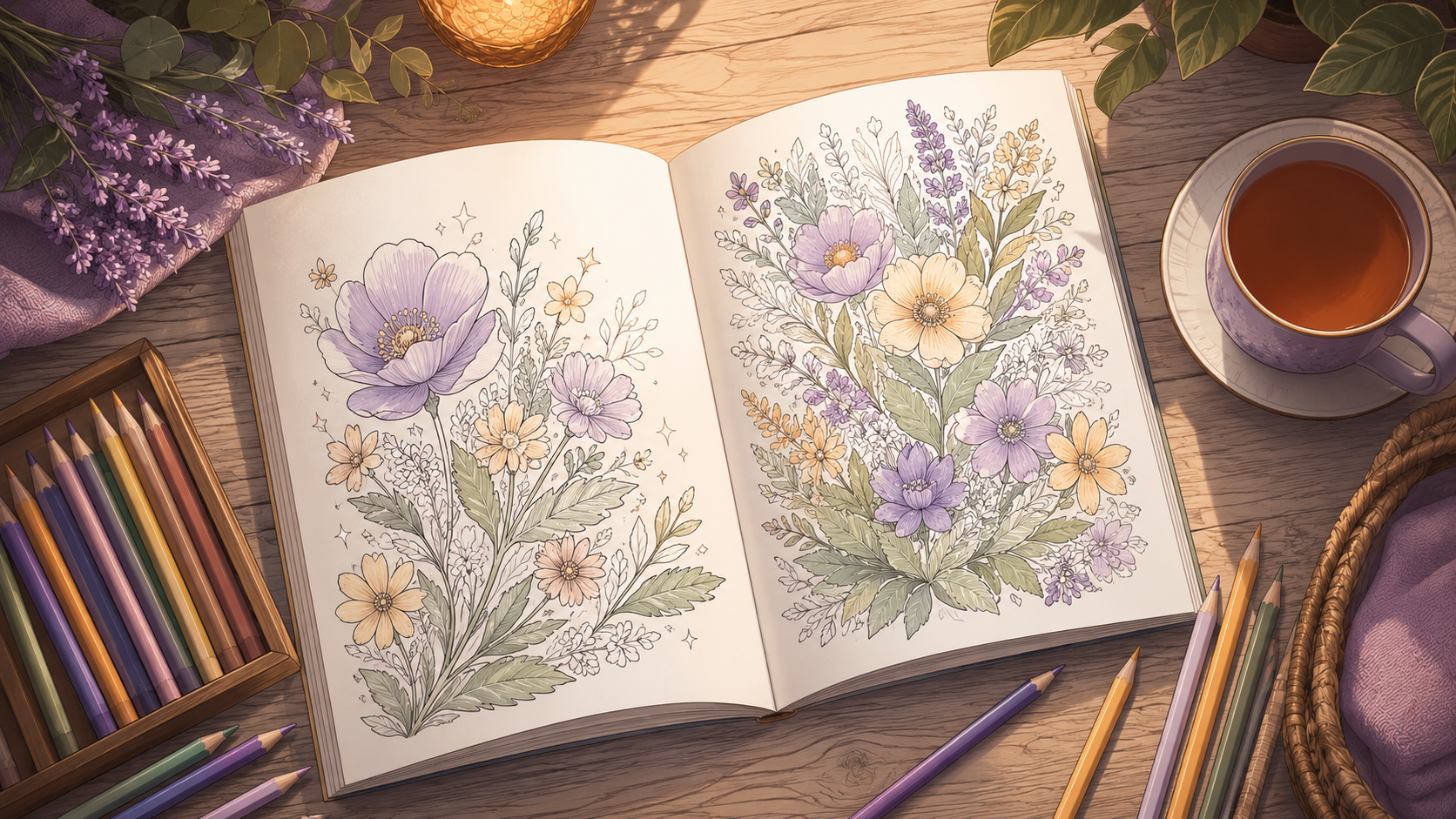
For a floral page, try:
- Lavender: most of the flowers.
- Sage green: leaves and stems.
- Honey yellow: flower centres and a few little accents.
Repeat those colours in different parts of the page. A honey-yellow detail near the top and another near the bottom can help the picture feel connected.
You don’t need to use equal amounts of all three. If each colour is equally strong everywhere, the picture may feel busier than you intended.

Does this mean the same thing as 60–30–10?
Not exactly. The 60–30–10 idea suggests using a dominant colour, a smaller supporting colour and a little accent, in roughly those proportions. You can borrow that idea for a colouring page, but there is no need to measure the space or count the petals.
A three-colour palette simply limits your main colours. It doesn’t require those particular proportions.
Is a three-colour palette always triadic?
No. A triadic palette uses three hues spaced evenly around a colour wheel. A limited three-colour palette can use other combinations, including neighbouring colours or a colour paired with neutrals.
If you want to experiment visually, Adobe’s colour wheel and palette tool lets you explore different colour relationships, including analogous, complementary and triadic schemes. Use the screen palette as inspiration, then test your actual pencils on paper.
Try these three-colour combinations
| Mood | Three colours | An easy way to use them |
|---|---|---|
| Soft botanical | Lavender, sage, honey yellow | Flowers, foliage and centres |
| Cosy autumn | Burnt orange, warm brown, muted green | Pumpkins, baskets and leaves |
| Quiet cottage | Dusty blue, beige, rose pink | Doors, walls and flower boxes |
| Woodland walk | Olive, ochre, deep brown | Leaves, light details and trunks |
For this exercise, the printed black outlines and white paper don’t count as extra pencil colours. You can also vary pencil pressure to make lighter and darker marks without reaching for another pencil.
Make three small swatches first. If you like them together, choose one object and begin. You can decide what to do with the background later.
Is coloring good for people with ADHD?
Colouring may be an enjoyable leisure activity for some people with ADHD, but preferences vary. It should not be presented as a proven ADHD treatment or a guaranteed way to improve attention. Someone may enjoy the hands-on activity, while another person may find the same page frustrating or uninteresting.
The National Institute of Mental Health’s ADHD guidance explains that ADHD can involve difficulties with attention, hyperactivity and impulsivity. It identifies medication and psychosocial interventions among standard treatments. A colouring page is not a replacement for appropriate assessment or care.
For a hobby, the useful question is personal: “Do I like doing this, and what makes it comfortable for me?”
Make starting easy
The following are optional ways to organise the activity, not a treatment plan:
- Put one page and a few pencils on the table instead of opening every supply you own.
- Pick a picture that interests you, whether it is simple or detailed.
- Choose one small area as a starting point.
- Keep another design available if the first one doesn’t appeal.
- Leave yourself permission to stop or change activities.
You could try a brief session and see how it feels. A timer can provide a stopping cue if you like one, but skip it if it adds pressure.
Avoid turning the page into a test
Finishing a picture, staying inside the lines or sitting still for a certain length of time should not be treated as proof that someone is managing ADHD well.
If you’re colouring with a child, offer choices and make room for movement breaks. Let the activity remain something you do together rather than a test of concentration.
Some people like a familiar pattern. Others want an imaginative scene or a different picture each time. There is no single design that will suit everyone with ADHD.
Notice enjoyment rather than promising an outcome
Afterwards, ask a simple question: “Would I like to do that again?” You might also notice whether the drawing felt too crowded, the pencils were comfortable or the session was too long.
Those observations can help you choose a more enjoyable hobby setup. They don’t diagnose ADHD or show whether treatment is working.
What are some fun things I can do with my coloring pages?
You can turn finished colouring pages into bookmarks, greeting cards, gift tags, journal decorations, small displays or personal craft projects. You can also enjoy the same design again with a new palette. Choose an idea that suits the artwork and the time you want to spend.
For the projects below, use pages in ways allowed by their licence. Personal craft use doesn’t automatically include permission to sell the artwork or share the downloadable files.
1. Make a bookmark
Choose a strip containing an interesting part of the picture. A row of leaves, a tall flower or a section of a pattern works well.
Trim it to a comfortable bookmark shape, attach it to a slightly larger piece of card and let the glue dry flat. Round the corners if you like. A hole and a small ribbon are optional finishing touches.
This is a lovely use for a page you enjoyed but didn’t finish.
2. Create a personal greeting card
Cut out a coloured flower, animal or small scene and mount it on folded cardstock. Leave room beneath or beside it for a short handwritten message.
Try “Thinking of you” or “A little colour for your day.” The message can be simple; the time you spent on the picture gives it a personal touch.

3. Make matching gift tags
Cut several small shapes from a patterned section, back them with card and write on the plain reverse. Keep the writing area clear enough for the name to be easy to read.
Consider what makes a good coloring page in relation to your mood and environment.
Reflect on your criteria for what makes a good coloring page to enhance your future selections.
A partly coloured page can make attractive tags, especially when you repeat one palette across the set.
4. Decorate a journal page
Ultimately, what makes a good coloring page is a reflection of your individuality and creativity.
Use a coloured border, a single leaf or a small flower beside a journal entry. Add the date and one line about the day if you want to.
Keep the decoration away from the binding so the journal still opens comfortably. You can use a small piece of artwork rather than covering a whole page.
5. Create a rotating mini gallery
Display a few favourite pages on a pinboard, clipboard or in simple frames. Choose a shared palette or theme to bring them together.
Swap the pictures when you feel like a change. Our seasonal and holiday colouring ideas offer inspiration for choosing different themes throughout the year.
6. Try the same page with two palettes
If your download licence allows reprinting for personal use, print the design again. Colour one version with a soft palette and the other with stronger colours.
Compare how they feel. Which areas catch your eye first? Which colours would you repeat? There doesn’t have to be a winning version.
7. Turn a scene into a homemade puzzle
Glue the finished page onto card and allow it to dry flat. Cut it into a few large pieces or several smaller ones, depending on the challenge you want.
Keep the pieces in an envelope with a small picture of the completed design, if you have one. Adults should handle cutting where needed, especially for younger children.
8. Share a colouring afternoon
Choose pages that each person is allowed to use under the download licence, put a few supplies within reach and let everyone choose their own colours.
You can agree on a shared theme, such as “three colours” or “woodland,” while keeping the results individual. Leave comparison out of it and ask what each person enjoyed making.
9. Keep a colour experiment folder
Save pages where you tried something new. Write the pencil names or colour choices on the back, along with a quick note about what you would repeat.
This gives your practice pages a purpose without requiring every one to become a gift or decoration. Some pages can simply be records of a pleasant creative hour.
What makes a good coloring page is clear outlines, enjoyable themes, and suitable detail levels. Focusing on what makes a good coloring page will enrich your experience.
Start with a design that catches your eye, choose three colours and decide whether you want to colour a small section or settle into a longer project.
For a free starting point, explore our 9-page floral colouring pack. Flowers give you opportunities to repeat a small palette and pick out details for personal cards or bookmarks.
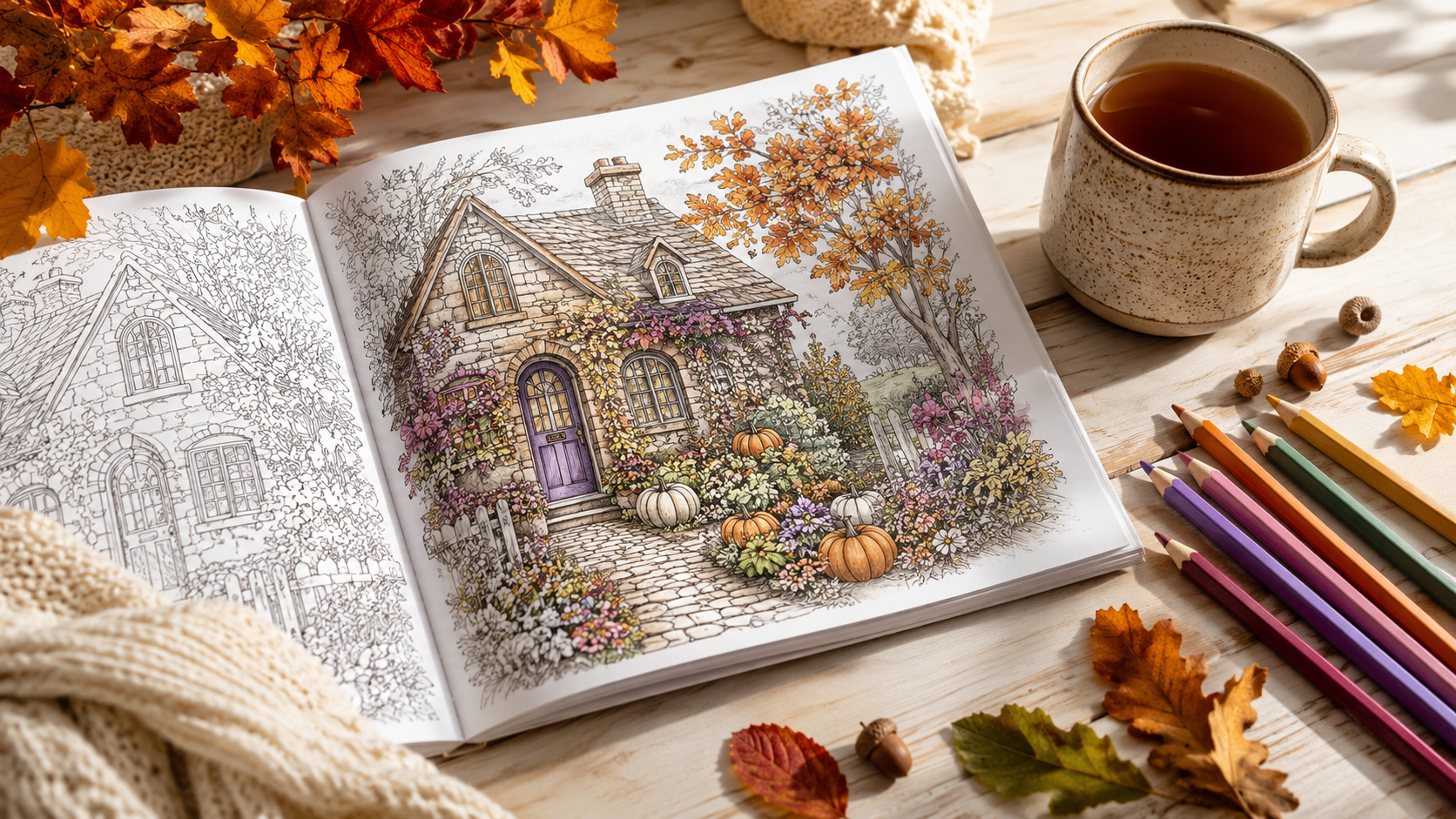
If you enjoy seasonal scenes, our Autumn Coloring Pages for Adults — 40 Cozy Fall Printables includes pumpkins, autumn foliage, cottages, woodland animals and other seasonal designs. It is a digital download to print at home, with pages in 8.5 × 11-inch format.
You can keep a page just for yourself, display it or give part of it a second life as a small craft. What matters is finding a way to enjoy the time you spend with it.
Which would you like to try first: a three-colour page, a handmade bookmark or a little gallery of your favourite pictures?
What are the easiest colouring pages for beginners?
Start with clear outlines, broad shapes and a subject you enjoy. Simple flowers, mugs, leaves and bold patterns give you room to practise without working around lots of tiny details. Choose one small section first rather than worrying about finishing the whole page.
Do I need expensive pencils to enjoy adult colouring?
No. Begin with the pencils you already have, a sharpener and a suitable page. Try light pressure and gentle layers before buying more supplies. Our beginner colouring tips explain how to get more from your existing tools.
Should I colour the background first or last?
Either approach can work. If you already know your background colour, adding a light layer first can help you choose colours for the main objects. If you’re unsure, start with the subject and decide later. You can also leave the background white.
Can I use more than three colours on a colouring page?
Yes. A three-colour palette is a helpful exercise, not a limit you must follow. Add another colour when you want to. To keep the page coordinated, try repeating your main colours across several objects rather than choosing a new shade for every shape.
How can I stop markers bleeding onto the next page?
Print single-sided on paper suitable for your markers and compatible with your printer. Place a protective sheet underneath and test a small area first. Alcohol markers can bleed through even thicker paper, so paper weight alone isn’t a guarantee. Avoid repeatedly soaking the same spot.
Do I have to finish a colouring page in one sitting?
No. You can colour one flower, one corner or a few sections and return another day. Keep your chosen pencils together or note their names on the back so you can pick up where you left off. Unfinished pages can also become bookmarks or small craft pieces.
Where can I find free printable colouring pages to try?
You can start with our free floral colouring pages. Choose a design you like and test your colours on matching scrap paper before beginning. A free pack is a simple way to explore your preferences before choosing a larger collection.
Choose a page and try one idea today
Start with a design that catches your eye, choose three colours and decide whether you want to colour a small section or settle into a longer project.
For a free starting point, explore our 9-page floral colouring pack. Flowers give you opportunities to repeat a small palette and pick out details for personal cards or bookmarks.
If you enjoy seasonal scenes, our Autumn Coloring Pages for Adults — 40 Cozy Fall Printables includes pumpkins, autumn foliage, cottages, woodland animals and other seasonal designs. It is a digital download to print at home, with pages in 8.5 × 11-inch format.
You can keep a page just for yourself, display it or give part of it a second life as a small craft. What matters is finding a way to enjoy the time you spend with it.
Which would you like to try first: a three-colour page, a handmade bookmark or a little gallery of your favourite pictures?


0 Comments